
The Compass Check
Four questions that quiet the crowd so you can hear what you already know

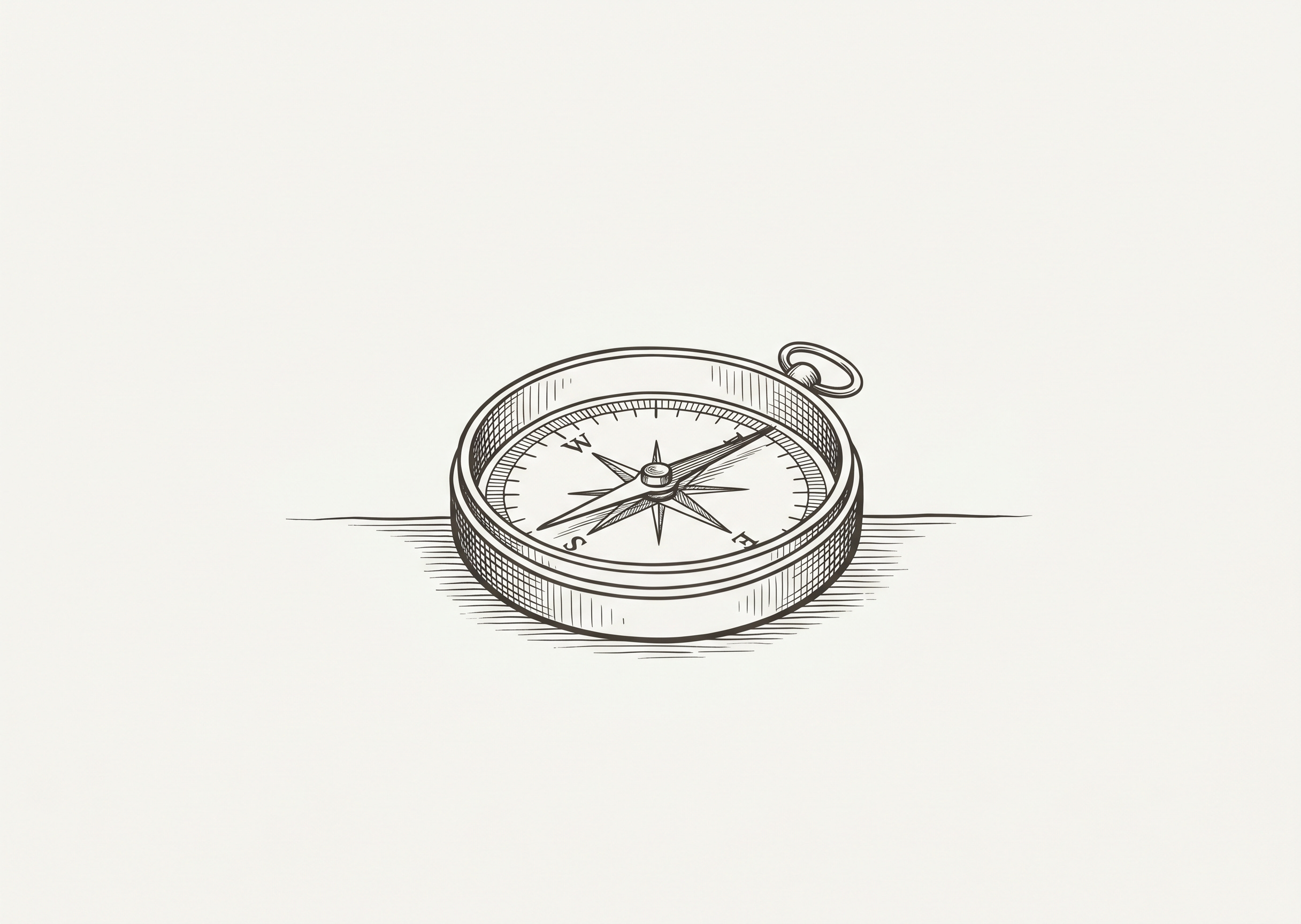
You’re standing at a crossroads, and everyone has an opinion about which way you should go. Your mother favours the safe path. A friend insists you’d regret the risk. The internet has seventeen frameworks for making the “right” decision. The group chat is already drafting your reply.
Somewhere underneath all of that, a quiet voice already knows.
The trouble at a crossroads is rarely a shortage of direction. There are too many voices, and they are louder than your own. The compass underneath is still working. It just needs a few minutes of quiet to be heard.
This practice gives it that.
Foundation: The Question Underneath the Question
(Start here.)
Find a notebook and a pen. Not a screen. Not the app you take notes in. Paper.
The reason matters. A screen formats your thinking before you have finished thinking it: into bullets, into the shape of what you would be willing to send, into the version that would survive an audience. Paper holds whatever you put on it, in the shape you put it there. Before any other voice is allowed in, give yourself a medium that cannot translate you.
Set a timer for ten minutes. Write this question at the top of the page:
“What do I actually want here?”
Not “what should I want.” Not “what would be sensible.” Not “what would be a good story to tell about myself later.” Just: what do I actually want?
Write whatever comes. Do not edit. Do not cross out. If a sentence sounds selfish, write it. If two sentences contradict each other, leave them both standing. You are checking what the compass is pointing at when no one is watching the needle. That is all.
Write until the timer goes or until your hand stops moving on its own.
If that alone gives you the answer, close the notebook. Sometimes the quietest version of this practice is enough.
Pillar: The Four-Point Check
(When the first question opens something but does not finish it, go here.)
Each of these four questions strips one thing away. An audience. A fear. A borrowed voice. A mind that has been busy out-arguing the body. What is left, after the stripping, is closer to the signal.
Take them in order. Write the answers down. Same notebook, same pen.
1. If no one would ever know what I chose, what would I choose?
This strips the audience. Imagine the decision happens in a sealed room. No one will praise the brave choice, no one will pity the safe one, no one will even ask which one you made. In that room, with no one watching. What do you reach for?
The gap between what you choose there and what you would choose in public is information. Sit with the size of it.
2. What am I afraid will happen if I follow my actual direction?
This strips the fog around the fear. Name it as specifically as you can. “It might not work out” is a fog sentence. Try: I am afraid I will disappoint my father. I am afraid I will look foolish. I am afraid I will discover I was wrong about myself for a long time.
Named specifically, a fear shrinks to the size of a sentence instead of staying the size of the room. Fear named is fear weighed. You can still choose to walk with it.
3. Whose voice am I hearing when I think the word “should”?
This strips the borrowed map. Behind almost every “should” stands a person. A parent, a teacher, a partner, an old version of yourself who made a promise on your behalf. Listen for the sound of the should. Whose cadence is it in? Whose disappointment is it imagining?
Name the voice. Then ask the harder question: is this voice still serving me, or am I carrying it out of habit?
4. What does my body know that my mind is arguing with?
This strips the noise of the argument and goes underneath it, where the body has usually already decided. Bring each possible direction to mind, one at a time. Notice.
Does your chest open or close? Does your breath drop into your belly or stay shallow in your throat? Do your shoulders rise toward your ears or settle down your back? Does the floor feel solid under your feet, or does the room go thin?
The body reports in sensation, not in argument. Write down what it reports for each direction, in whatever words you have.
The four answers will not always agree. The sealed room may reach for one thing while the body leans toward another; the fear, named, may turn out to be the wisest voice on the page rather than the one to strip. When they pull against each other, do not force them into line. Where the four disagree is exactly where the real decision lives. Write down the disagreement too.
Exploration: Signal and Noise
(For when the page is full and you need to read what is actually there.)
Read back over what you have written. Slowly. Out loud if you can.
Look for the place your wanting keeps showing up. Even when the path is impractical, even when it would be inconvenient to admit — where does the compass keep pointing? That repetition is the signal. Underline it.
Look for the voices that belong to other people. Phrases that sound like someone else’s vocabulary. Sentences that have the shape of advice you have been given many times rather than something you would have said unprompted. Those are borrowed maps. Keep what is genuinely useful for terrain you have not crossed. Set down the rest.
Look at the difference between fear and wisdom. They can sound similar on the page. The body knows the difference. Fear lands as constriction: a tightening across the chest, a held breath, a sense of the walls coming in. Wisdom lands as a kind of solid quiet, even when the answer is unwelcome. An answer that makes you sad but steady is usually wisdom. An answer that makes you tight and busy is usually fear talking.
This reading takes practice to trust. A body that has braced for years can offer a flat calm and call it peace, or read a true yes as alarm. The longer you keep checking, the more cleanly the steady quiet separates from the frozen one.
A short note on other people. Outside perspective is useful; the real question is what their input does in your body when it lands. Recognition settles: a yes, that one, a small dropping of the shoulders. Obligation tightens: a held breath, a sense of being moved by someone else’s hand. Keep what settles. Set aside what tightens. Your body knows which is which — and the more you listen, the more clearly it will tell you.
Sometimes the page comes back quiet. No phrase repeats, no wanting keeps surfacing, nothing underlines itself. That is not a failed reading. Some crossroads are genuinely two roads, not one road and a fog — two things you want that cannot both be had. When that is what the page shows, the work is not to find the hidden answer. There isn’t one underneath. The work is to see clearly what each road costs, and to choose which loss you can carry. The compass has not broken. It is telling you that here, you are the one who decides — not the needle.
Integration
(For after.)
A compass that is checked once and put on a shelf will drift. Yours will too. Check it again when you are facing a decision that matters, when you feel confused despite having enough information, or when you notice yourself performing a choice rather than making one.
The more often the practice happens, the smaller it can become. Eventually the ten-minute version becomes a one-minute version. Eventually it becomes one unnecessary sentence between two ordinary moments — the same shape as the doorknob practice. What do I actually want here? And four seconds of listening for what answers.
One question. One pause. The whole compass in the gap between two tasks.
That’s enough.
Which of the four questions revealed the most? What surprised you?
Whose voice did you discover you had been carrying?
What did your body know that your mind was still arguing with?
This practice has been sown in fields of:
Aspect: 🧭 Direction
These are missives from the mid-journey. If they speak to you, then I invite you to subscribe.
Hamish
🙏🙏