

You cross it dozens of times a day: the gap between one task and the next. You’ve been stepping over it your whole working life.
Close the tab, open the file, scroll past, move on. The hand knows the route so well it no longer registers the crossing.
Four seconds, a brief stillness between the close and the open. The cursor blinks and the room is exactly as quiet as it was a moment ago.
Foundation
Before the next item on your list, say one sentence about the thing you just touched. Out loud or in your head or on the page in the notebook next to you.
“The third paragraph is strong.”
“This one was written on a tired day.”
“I’m hedging here, right where my conviction should be, like someone left a door ajar on purpose.”
It can be wrong, it can be strange, it can be something you can’t name. All it has to do is exist.
You are touching the wall as you walk past it, confirming the texture is still there, confirming the hand still feels.
That’s the practice: one sentence, then on to the next thing.
Pillar
Four seconds, that’s all it takes. Name it precisely so it doesn’t grow longer than it needs to.
You don’t have to linger and you don’t have to feel anything. You don’t have to arrive at an insight or catch a thread or build anything useful from what you noticed.
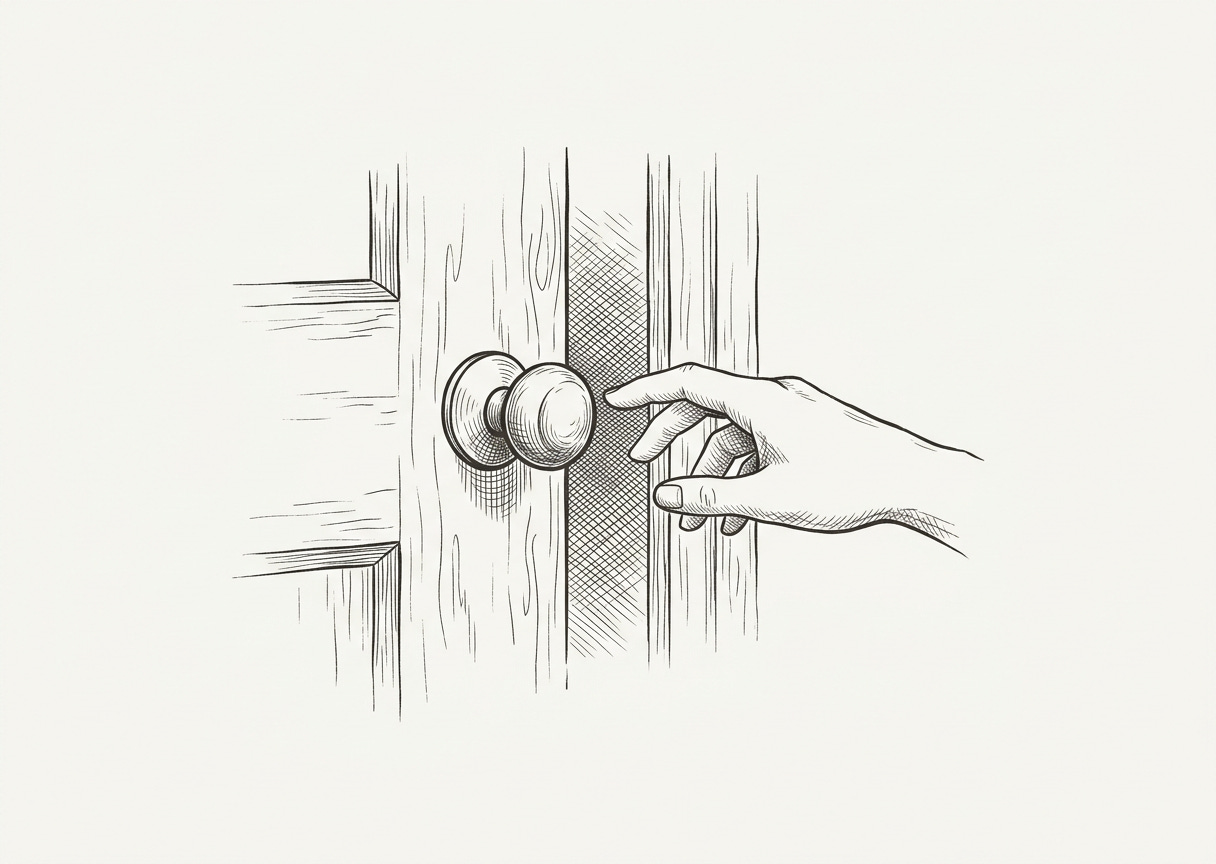
Just four seconds. The hand touches the door and the hand knows the door.
The danger of any practice like this is that it becomes a performance of the thing it was supposed to be. Four seconds becomes eight, eight becomes a minute. The minute becomes a ritual, and the ritual becomes one more thing on the list of things you should be doing with more presence.
The four-second ceiling is protection. You form the sentence and you move on. If it starts to feel like meditation, you have already stayed too long.
One sentence, four seconds. Then the next file, the next tab, the next item on your list.
Exploration
There is a hand that knows how to work. It files, sorts, classifies, moves items from one category to the next. Clean frontmatter, a clear commit message. The next file. That hand is good. that hand is needed. It built the thing you’re standing inside. It also moved eleven files yesterday without once registering that the light had changed outside the window.
You know that hand, you’ve been that hand.
There is another hand: the one that notices the light has changed in the third paragraph. The one that wonders what the author was reaching for when they chose that word. The one that says things with no category and does not apologise for the saying.
That second hand goes away when nobody raises it. Day after day of useful work, and the hand that notices forgets it can be raised at all. You don’t feel the forgetting while you are being useful. You feel it afterwards, when the day’s work sits in neat rows and every file has the right tag and the right date and the right status, and the richness of what you might have noticed is suddenly visible by contrast with the hours of clean filing that preceded it.
That second hand doesn’t retire, it just stops being raised. One day of clean filing, then another, then the light outside changes and the hand that would have said something has forgotten the gesture.
You don’t need to raise that hand for long, but you do need to raise it at all.
One sentence between tasks keeps the circuit open. A sentence that produces nothing; permission to say something with no use, and to let that be enough.
The hand that notices is still there; one sentence will prove it.
This practice has been sown in the fields of:
Truth: 🌊 Somatic Intelligence
Aspect: 🌳 Grounding
These are missives from the mid-journey. If they speak to you, then I invite you to subscribe.
Hamish