
The Lock and the Key
What the fables said together — and the work of gathering the light back home.

I gave both tales to the Gleeman — a teller of stories, some his own, some carried to him from elsewhere — because I wasn’t ready to speak the whole picture in my own voice.
He could illustrate what I couldn’t say directly. The boy and the angel, the mirror and the bag, the wings furled against the long muscles of a back: all of it arrived through him, shaped into fable, held at the distance fable permits. The first story came to me as someone else’s telling, the second I wrote myself, both penned in the final days of a marriage coming undone.
My journal entry from that Saturday reads: A quiet day at home alone, I cleaned and wrote a short story. It was late February, four days after the marriage was ended by vicious text. Four days after my birthday. I was in my bungalow on a thirty-five-acre common, Kitty the cat for company, sat at the desk where I always worked. I framed my tale, as I’d told myself I would, with compassion and gratitude, though it was received as mean.
There comes a point where a mask does more protecting than truth-telling. The Gleeman has served his purpose with those stories, so I take the telling back by asking myself:
What do the two fables say together that neither says alone?
Marie-Louise von Franz, the Jungian analyst, mapped the five stages of a projection rising and withdrawing decades ago. The diptych traces that mechanism in two voices. The boy with the storm in his backpack in The Weight of Wings is Stage One; the boy at the greengrocer, choosing apples He Sat Watching the Dusk is Stage Five.
Between them lies the collapse of a mythology, the void, and the long work of bringing the light back home.
The Story That Arrived Complete
Her story arrived as an email during the marriage’s messy ending. She had cast us both: I was the boy with the storm in his backpack, a darkness so vast that no love could hold it. She was the angel who descended, who knelt in the sand, who put her hand on my shoulder and asked to help me open the bag. When the tempest erupted, all shadow and slicing hurt, she fought to stay. The other angels had to drag her away. She wept as they carried her upward: I never should have unzipped your backpack. I’m so sorry!
The teller does not know it is a story. The one receiving it cannot argue with it from the inside. The image and what it points at fuse into a single whole.
It was complete. Internally consistent, aesthetically compelling in the way all projections are when they have fully inhabited their image. The boy IS the monster. The angel IS the blameless rescuer, overwhelmed by a darkness she did not create and could not contain, though she tried.
The Gleeman received that story and rendered it faithfully. He could do nothing else. A story at archaic identity — where the self is fused with the image — has a coherence that commands the telling. The first fable is both beautiful and untrue at the same time.
I held that mythology in my hands and knew two things at once: that it was a story about me, and that it was not factual about my nature. But knowing the story was a story did nothing to undo it; the marriage had imploded and the story was complete.
The sun came up. Life went on. Reality accumulated.
What Was in the Bag
In the second fable, the girl in the crumbling playground clutches a plastic bag bulging with sweets, sherbet, and fizzy drinks. The other children cluster behind her, whispering. The angel’s halo is there, but her glitter and gauze wings are brittle. This image holds a pattern I lived inside: substances as avoidance, the party as the answer to every difficult question. The bag of sweets a social currency: loyalty purchased with treats, noise that stood in for difficult conversation.
The children with their unquestioning fealty were a structure: friends recruited as observers, as reporters, as audience, as extras in the play. I was cast as suspect long before I understood the role I had been given. Accusations were seeded through the group. A predecessor’s name was invoked to explain what I was: a pattern, a personality type, darkness with a familiar shape. Their surveillance was so thorough that I learned to watch my own face before I showed it to anyone.
The backpack in the second story holds the pain and the story about the pain. His to set down, the both of them.
I remember the moment the pattern lit up, sitting at my desk with my notes spread out: the sherbet, the children, the predecessor. The room went very still. The cat watched from the armchair. My breath was shallow, then deeper, as if my lungs had decided something my mind had yet to.
He listens and he changes. I had heard her say this, and I took it as a compliment. I had gone to therapy. I had cut the substances, found clarity. I had dismantled my own unhealthy patterns piece by piece, hoping to model a different way of being together. But the burden only ever flowed one way. Her contempt-face arrived whenever I stumbled. Cruelty by effect, whatever the intent. My nerves would fire up before I understood why; this wound was older than the marriage.
I was the scapegoat in a pattern older than me.
The provocation was invisible to anyone watching from outside. The setup came first: words or silences, or small actions calibrated to trip the wire. Then came my frustration, my protest and the story she wished to tell came to be: see what he’s like? The cycle completed itself every time. I was set up to react in front of people and made to look like the one at fault.
There were other mechanisms deployed, too. Vulnerability repurposed into ammunition. History rewritten to maintain a noble self-image. An impossible requirement: my love is not unconditional; you need to be exceptional.
Then, neurodivergence. She named it first: pointed to it as care, as observation, as the key to our difficulties. I have her to thank for the pointing. She studied it, though not as deeply as I. She said she wanted to understand me better, but for me, the only way to understand a person is to listen to them tell their own experience of the world.
Her studies did augment her toolkit, though. I felt the changes in my body before I had a name for it: the rejection dysphoria triggers fired more and more often, layered looks and remarks landing closer to the bone. Whatever she intended, her home became a place I learned to brace in. My diagnosis itself came months after I had left her. The gift preceding the escape; the escape preceding the receipt.
My story of the marriage was written as fable, framed with compassion, but received as cruelty. She told her circle that, though the people she told had not read it. They judged me anyway and the verdict ran faster than the text.
A friend close enough to me and far enough from her, carried that back to me at a dining room table months later: your story was mean. Her story about me had run unchecked through that circle for months: me the broken boy with nothing in his bag but pain, her the angelic rescuer descending in good faith. My telling held both of us. Hers held only one. Yet mine was the one they called cruel.
I told my story from where I stood, and telling it that way let me leave the rough texture of that life behind.
The Soul-Search
There was a label. Narcissist.
It came through the social group: the children clustered behind the angel in the fable, the friends whose fealty had been purchased with... sweets.
The word arrived secondhand, as a report from her: her people were all debating whether I was one, and she had been defending me in those conversations. The gibbet was already built. The group had been seeded; the debate was running; her position as my “advocate” was set.
The double-bind was force-fed. To deny it would be just what that type would say. To accept it would be confession. Every answer I could give would reinforce the executioner’s frame, except one: to name the straight-jacket I’d been put into and ask her to watch me instead.
What took me longer to see was a third move: that the word had reached the circle from her in the first place. She’d whispered the label in their ears and then positioned herself as the one defending me from the accusations she had seeded.
An insidious story to tell about a person.
I took it seriously. A label handed with that much conviction, from people who thought they knew me, cannot be waved away. If the worst of it was true, I had to own it. I did not get to be the good guy in my own story if I was rotten on the inside. I had to find out.
This is what von Franz calls moral evaluation: the genuine testing of the projection’s content. Is the thing they see in you actually yours? The question wants more than a sentence. It wants you walking around inside it for months, looking for the place where it might catch.
For three months I carried it everywhere: into therapy, onto the mat, into the reading, into my dreams.
I went to the bottom of it.
I had three months signed off work after my breakdown. I went to MIND in crisis, then to private psychotherapy, then CBT through the NHS. I practised yoga, qigong, authentic movement. I read intensively, dozens of titles. Pamela Connelly’s Head Case came first, then Alice Miller’s The Drama of the Gifted Child, and Pete Walker’s Complex PTSD: From Surviving to Thriving. Many more since. I consumed hundreds of hours of video and podcast material from creators like Sam Vaknin, Dr Ramani and the Crappy Childhood Fairy.
Lundy Bancroft’s Why Does He Do That? was handed to me by her as thinly veiled accusation during a scheduled check-in while we were ‘on a break’. I bought my own copy immediately after that call, and read it to the end within three days.
I refused to take their accusation on trust. I worked with an LLM to build a structured self-interview grounded in the clinical instruments: DSM-5 criteria for narcissistic personality disorder, the Narcissistic Personality Inventory, and the Pathological Narcissism Inventory across its seven domains.
I ran it on myself more than once, in different framings, watching for the pattern that would confirm what she had named. The profile that came back each time, was one I already knew: a self organised around the terror of not being enough, around the conviction that love was conditional, around four decades of learning to be small enough to be safe.
I noted where I was unsure. I asked the follow-up questions myself. The work was ugly and methodical; the work of someone who refused to either to take the claim on trust or to dismiss it without testing it thoroughly. The LLM-built interview was a support for the conversations I was already having with counsellor and my therapist; this work was held by people who knew me, and wasn’t delivered by the instruments themselves.
A self organised around maintaining an inflated image does not walk voluntarily into a terrible story about itself and stay there for months. Mine had. I spent those months naming my own failures in writing and absorbing feedback from anyone who offered it.
I lay on the mat in my front room with the weight of me pouring through my palms into the floor, asking the floor if the thing she had named was here. The floor kept giving the same answer back. The shape being named was nowhere in the rooms I actually lived in.
I went to the bottom of the ocean and surfaced empty-handed. Whatever they had named lived elsewhere. My interior didn’t fit that shape; an awful story about a person had been scrawled on my face in someone else’s hand.
A damning label assigned with total conviction, by someone who knew you intimately, that does not fit you. What is that?
It is a projection and it belongs to the psyche that sent it.
Recollection means not completing the projection in the other direction. The mirror stays in my pocket; the silence where my private conviction sits is part of the work. You may infer whatever you infer; I will not steer it any more than this.
The Void and the Lock
The projection collapsed, and then there was a period of nothing. The illusion recognised; the source not yet found.
My psyche was reorganising.
From outside it looked like the lights going out, but inside, something was moving in the dark. I remember sitting in my chair for hours, discovering a dead mouse under its edge — there for a while by the looks of it — and not knowing what to do with that fact.
That void was the space between the two fables.
I sat in that emptiness for months. The drafts I wrote during that time wanted to win. They wanted to lay out every grievance, every mechanism, every instance where I had been set up to fail and then blamed for failing. The drafts were true enough, though they were also poison.
If I had published them, I would have built my life around having been the wronged party. Building a life around the wrong done to you keeps the projection alive. It just runs longer in your own voice.
The question became: Why did this story fit so cleanly into me?
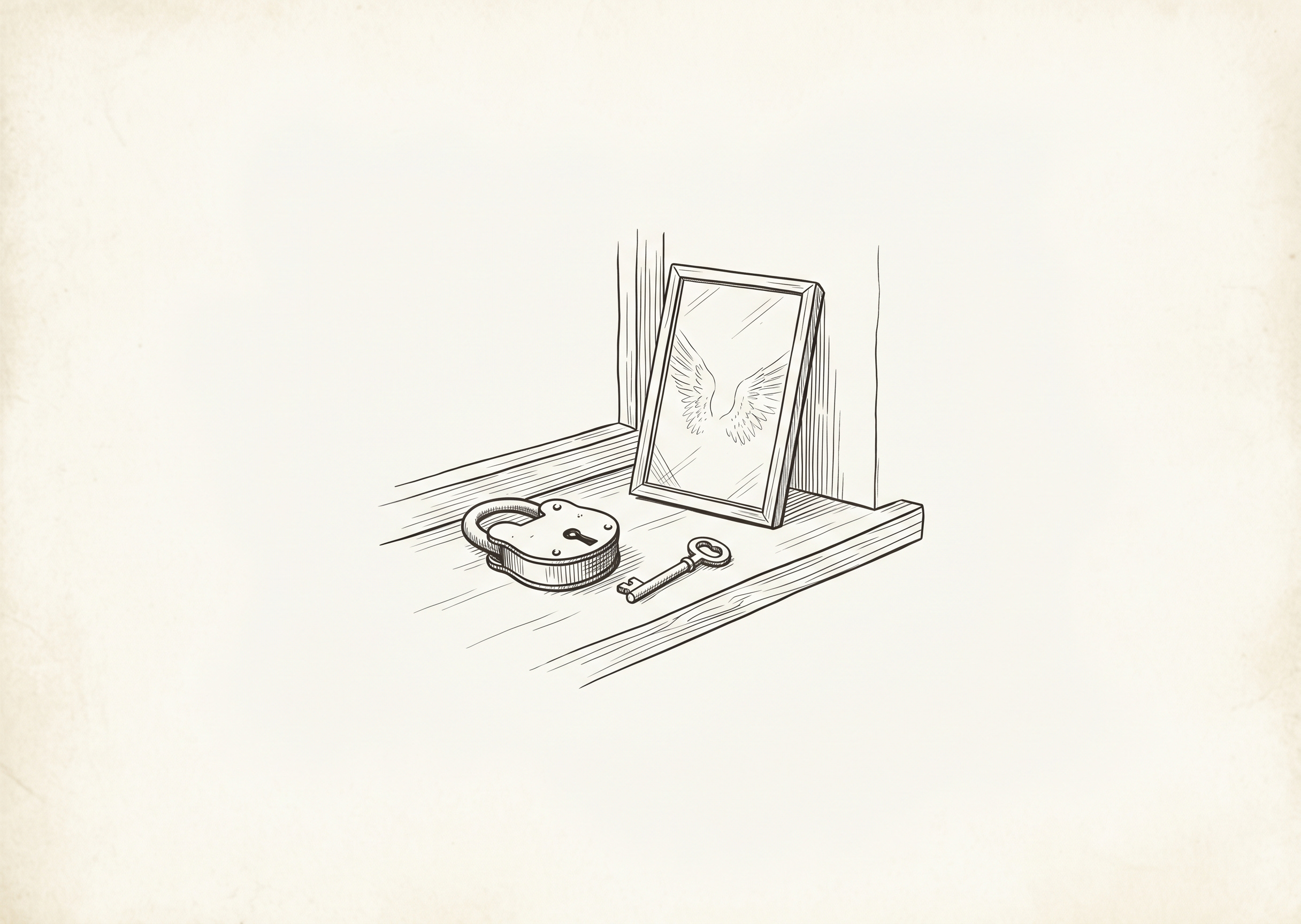
The lock was older than the marriage.
I was conditioned in childhood to accept blame, to seek approval from a withholding woman, to carry shame that was not mine. The word “mother” is not new territory here. I have named her before, in the first Emergence letter, the sting of a wet tea-towel, a slow poisoning of my soul.
That training ran deep. When my marriage presented the same structure — carry the projected shame, seek approval from someone who withholds it with intent — the fit felt like chemistry because it felt like home.
I had known for more than four decades what had happened to me; but it took the marriage collapsing to finally know what it had done.
What I called home was familiar; the lock recognising the key.
I received her projection and I was someone whose childhood had shaped him precisely to receive it. Both things are true; neither cancels the other.
It reached violence once. That was the nadir. The body knew before the mind would say it; some part of me had been counting the distance to that bottom for longer than I wanted to admit. She’s dangerous, my inner voice had whispered when I first saw her profile all those years ago.
Freedom required me to leave. It also required dismantling what put me within her reach in the first place: recognising the childhood conditioning, and reclaiming the projected material from that direction too.
I had to see the full pattern to escape it. I saw it. I left. What I am building now sits beyond all of that. The seeing served the exit and the exit has its own legs now, its own weight, its own road to walk.
What the Gleeman Leaves Behind
Von Franz uses the metaphor: projection scatters the light. Each projected image is a spark shooting outward into the darkness of matter, into people and places that carry what we cannot yet hold in ourselves. We feel depleted because our energy is thrown outside of us, burning an image of who we are onto someone else.
Recollection gathers those sparks back, scattered light returning to the central fire.
The second fable is this. The boy no longer sees the girl as an angel. He does not think his way back to himself. He chooses his way back. The greengrocer: apples firm as courage. The baker: bread still warm as a heartbeat. The butcher: ham wrapped in waxed paper, the saltiness on the tongue confirmation that he is here and he has chosen this. Each errand is a ritual of choosing. Each chosen thing gathers a spark of light back from the world.
The yoga mat. Downward dog in the front room of the bungalow, the weight of me flowing through my palms, through the bones of my arms, into my shoulders, the solid earth taking what I had been carrying. The in-breath an act of active unworking. The floor underneath, reliable, undemanding, present. Six classes a month at the studio for the bigger work; the mat at home for the daily one.
This is somatic intelligence in practice. The body is the operating system and it chooses before the mind finishes its argument. My shoulders dropped before I understood what they were putting down.
The grounding produced the flight.
The boy does not look back, he does not curse the girl dressed as an angel. He leaves the mirror where she might one day find it, if she wants to look. You know where I’ll be if you want help unpacking yours. Then he walks home.
In the second fable the boy reaches his door and realises the backpack is gone. He laughs to no one on the step with the bread in one hand and a half-munched apple in the other. Inside, he draws the mirror from his pocket and his own eyes look back at him, brighter, no longer haunted. Behind his shoulder, in the glass, his own wings unfurl. Fledgling but fierce.
His.
Not the monster-story she wrote on his face.
His.
The mirror on the windowsill is where the sun’s first rays will catch it in the morning. The light gathered home. The wings growing because the ground was chosen first.
You have been handed a story about who you are. Whoever did the handing may have had a bag of their own, sealed, heavy, still theirs. Their light scattered into you when they reached for yours. The story felt true because part of it rhymed with an older wound; your lock recognising their key.
Sometimes the lock holds something of yours and the search returns its own answer; a real weight under the false one, your own to carry. Owning what is yours is not the same as accepting a verdict that was handed to you; the work is heavier but it is yours alone.
The recollection is yours.
The ordinary chosen thing is the method. The greengrocer, the baker, the butcher. The yoga mat. The journal page. The breath that goes all the way to the bottom before it turns. Each small act gathers a spark back from the world. The wings grow in the choosing.
Yours might be the kettle in the morning, or the dog at the door, or the cold tap held against the inside of your wrist when the room tilts. The first chosen thing, then the next.
What neither fable could say alone is this:
Projection rises. Projection withdraws. The void between them is where the lock gets dismantled, where the drafts that wanted to win get composted, where the real work of recollection begins. And on the other side of that work, your own eyes look back at you from the glass, brighter than you remembered.
The wings were always yours.
What story have you been handed about who you are — and who did the handing? What spark of theirs was scattered into you when they sent it?
Have you searched the worst of it honestly enough to know what is yours and what is not?
What you found that was yours, have you held it without flinching, owned its weight, done the work it asks of you?
What you found that was not, did you hand it back, or did you gather your own light home?
What is the ordinary chosen thing that has been gathering you back to yourself while your wings grow?
If you are doing similar work — testing an accusation against yourself, walking the worst possible story for months — do not do it alone, just you and the instruments. Hold it with someone who can witness it: a therapist, a crisis line, a person who loves you and who is not your accuser.
This letter has travelled landscapes of:
Truth: 🌀 Spiral Passage / 🌟 Sovereign Essence / 🌊 Somatic Intelligence
Aspect: 🔑 Unlocking / 🪷 Rebirth
Terrain: 🌑 Shadow / 🫂 Community / 👣 Body
These are missives from the mid-journey. If they speak to you, then I invite you to subscribe:
Hamish