

The Knock
A practice for listening to the walls you built and the body that carries them.

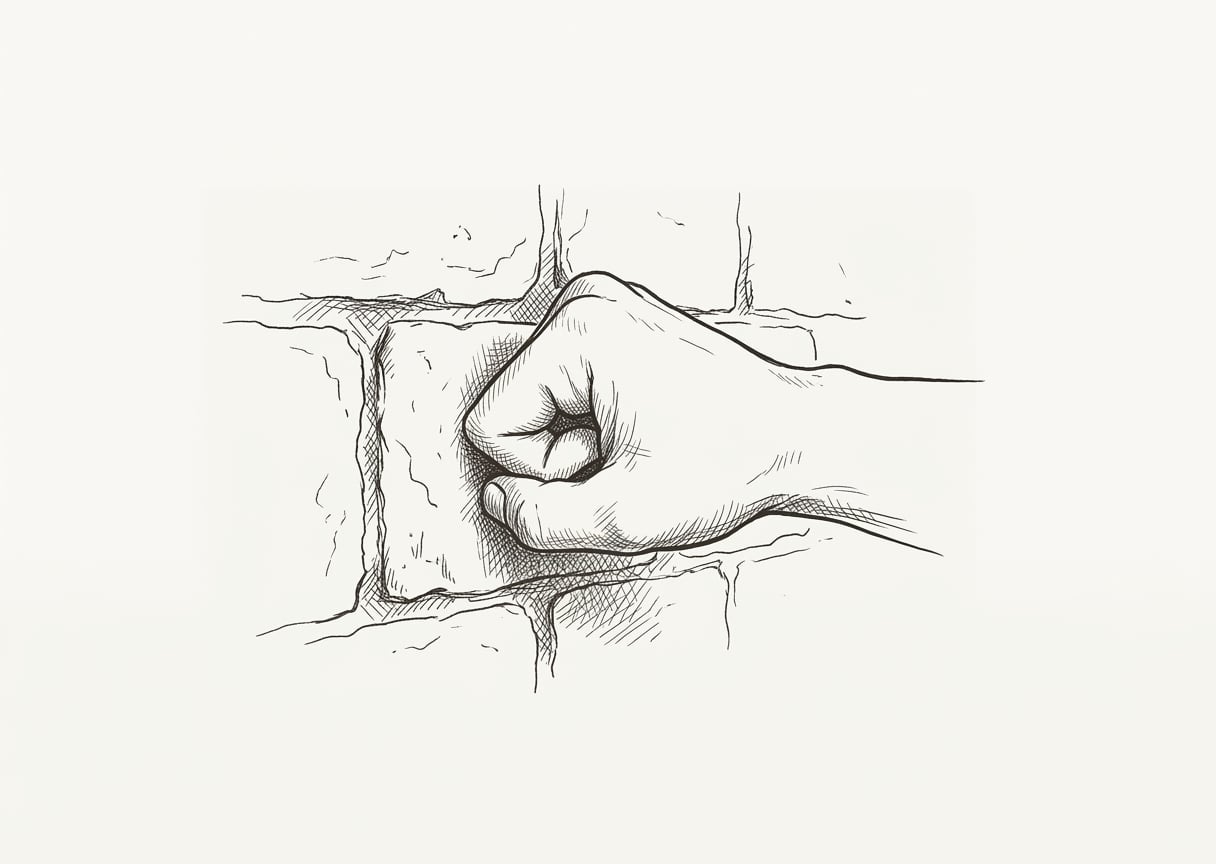
Four people knocked on the same wall over the last two weeks. Each one heard something different.
This is the last piece in the series. If you have read the others, you have already walked the building: the fire, the cracks, the survey, and the cost.
If you have not, it does not matter, this practice stands on its own.
You do not need a tour of the building to knock on a wall. You just need a wall.
The Wall
You have one, at least. You built it yourself, or you inherited it, or it was already standing when you arrived and you never questioned it because it looked like the edge of the world.
A rule you live by. The boundary you drew after the last time you let someone in too far. The identity you present at work: competent, reliable, fine. The story you tell about why your life looks the way it does.
Pick one. Not the one that is already crumbling. Not the one you know needs work. Pick the one you are proudest of, the one that functions. The one that, if someone questioned it, you would defend.
That is the wall worth knocking on.
The walls that are already cracking will tell you what they need whether you ask or not. It is the walls that look fine from the road that carry the information you have not heard yet.
Some walls will answer the knock by telling you they are exactly where they should be. That is also useful information.
The Knock
Ask it one question.
What would happen if I removed you?
Do not think your way to an answer. Ask the question and then sit still for ten seconds and notice what happens in your body before your mind gets hold of it.
A surveyor’s hands feel a three-millimetre movement in a wall before the instrument confirms it. Ask the question. Wait. Your hands will tell you what the instrument hasn’t.
Ask the question. Wait. Feel what arrives.
What You Hear
There are three sounds a wall makes when you knock on it.
The first sound is relief.
Your shoulders drop. You did not know they were up. Something loosens in the chest, nothing dramatic, not a sob, just a small release, like setting down a mug of cold tea you have been carrying room to room without drinking. The breath comes a little deeper than the breath before did.
That is the sound of a wall that is standing out of habit. It served you once. It may have saved you. But the weight it was bracing against has shifted or gone, and now the wall is not protecting you from anything. It is just standing there because nobody told it to stop. The maintenance costs you energy you have stopped noticing.
You do not have to take it down, but you heard the relief. That is information to hold.
The second sound is terror.
The stomach drops. The hands grip. Something in you says no before you have finished asking the question. A fast one, from somewhere old and deep. The kind of no that does not explain itself. The same reflex that makes you pull your hand back from a stove before you have registered the heat emanating from it.
That is the sound of a wall that is carrying the load of something you have not named. You built the wall so you would not have to look at what is behind it. The terror is the wall telling you it did its job. The knock told you something behind it is still alive.
You do not have to look behind it today, but you heard the terror in the echo of the knock. That is information to hold, too.
The third sound is nothing.
You ask the question and nothing happens. No relief. No fear. No feeling at all. Just a blank. You cannot imagine the wall not being there because you cannot see a wall at all. It is the ground, it is the shape of the room, it is the edge of what is possible.
That is the sound of a wall that has become invisible. You cannot maintain what you cannot see. You cannot choose what you do not know you are choosing.
The wall might be the soundest structure in your life. It might be the one that is slowly grinding you down. You cannot tell from inside, and the inability to tell, the blankness, the nothing, is itself the information.
If the blankness has a weight to it. a heaviness rather than an emptiness, then that is a different signal. Some bodies go quiet because they learned a long time ago that feeling was not safe, not because there is nothing to feel.
You do not have to do anything with it, but you heard the silence and that is enough.
Where It Stops
You knocked. You heard something. Relief, terror, or the silence that means the wall has become the room.
The practice ends here. What comes next is yours.
If the knock opened something that does not close on its own, that isn’t a failure. Some walls hold things that need more than a knock to address. Some of them need a sledgehammer or a wrecking ball, others need a buttress or some stitching or to be re-rendered.
A surveyor who finds structural damage does not fix it alone.
Now you know something you did not know five minutes ago: new information about the walls, and what they carry, and whether they are still carrying it for you or whether you are holding them up.
A surveyor reads the structure and writes the report, then puts the equipment back in the van and drives home to make dinner. Probably pasta.
What the owner does with the report is not the surveyor’s decision.
What did the knock tell your hands?
What is the wall holding that you’ve stopped naming?
If the wall came down tomorrow, what would the room look like without it?
The knock happened, and you cannot unknow what the wall told you. What you do with it is yours: these are your walls; this is your building.
This practice has been sown in the fields of:
Aspect: 🔑 Unlocking
These are missives from an active passage. If they speak to a truth you’re also walking, then I invite you to subscribe.
Hamish