

Hold
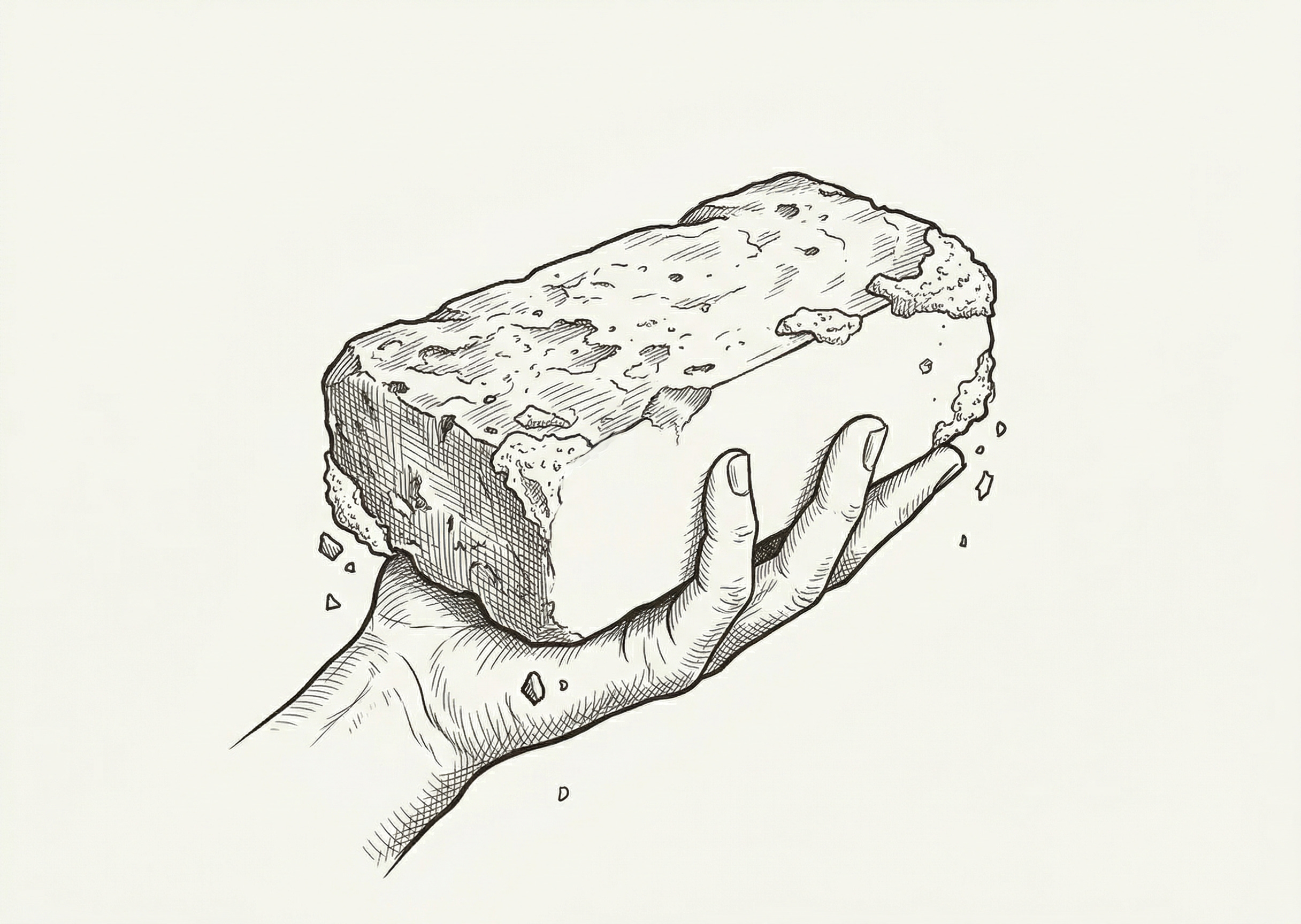
You have been holding this thing so long you forgot it was a choice. A relationship, a system, a routine you built when everything else was falling apart. Your fingers have forgotten any other shape.
You can feel the two options from here.
Hold tighter. Or let go. Force or surrender. White-knuckle or knock it down.
You have been choosing between these two for longer than you realise, and both of them leave you standing in the same place: staring at the thing, exhausted, with your hands aching.
There is a third option.
You have never been offered it, because the people around you only know the two. But it exists. A surveyor would recognise it immediately.
Wall
In building surveying, there is a word for this: repointing.
A wall fails for one of two reasons. The bricks themselves crack, split, lose their structural integrity. That is a demolition job, the wall comes down. Maybe it gets rebuilt.
But most walls fail at the joints. The mortar between the bricks deteriorates: weather, time, nature, neglect. The bricks themselves are sound, but the thing holding them together has given way.
I surveyed a ha-ha wall at a National Trust property in Norfolk. Four long sections of it, each telling a different story. One eighteen-metre stretch was pulling away from its pier, a vertical crack opening where the two should have been bonded together. That needed stitching with stainless steel bars bedded into every third course. A structural intervention.
The section next to it was forty-three metres of brick that looked just as bad at first glance, though it only needed pointing up. The joints had failed, not the wall. We raked out the old mortar, and pressed fresh lime into each gap. Many of the bricks that looked spent, their faces spalled, were lifted and turned. The face that had been protected inside the wall presented outward.
Same bricks. Different hands.
Repointing is slow work. One joint at a time, cutting back to where new material can bond. The shape stays. The structure stays. What holds it together is replaced from within.
A wall that needs demolishing and a wall that needs repointing are different jobs entirely.
One means tear it down. The other means change your hands.
Mortar
Walk back over the wall you just read about. Eighteen metres pulling from its pier. Forty-three metres that only needed their joints seen to.
How long had someone been asking the wrong question about that second section?
Look at the thing you have been holding. This is the surveyor’s problem: the closer you are to the wall, the harder it is to read the crack.
You have been asking yourself one question: should this survive?
Keep it or let it go. Stay or leave. Force it to work or admit it has failed.
That question has an assumption buried in it. The assumption is that the structure itself is the problem, that the wall is bad, that the bricks have cracked.
But what if the bricks are sound?
What if the thing that is failing is the mortar, the way the structure has been held together? The energy you bring to it. The grip you have been using. The material you have been filling the joints with: obligation, or fear, or the version of yourself you thought the structure needed.
Your hands know the grip they’ve been keeping. The angle of the hold. The particular tightness. Whatever has been the filler is in the muscle memory now. Obligation. Performance. The version of you that the structure required. You will reach for the next thing and use the same material. Demolition does not empty the hands.
Hands
You can ask this of anything you have built.
The relationship you are white-knuckling through. The career you maintain by performing a version of yourself that fits the room. The grief you have been managing by staying useful to everyone in it. The old argument you have been having for seven years at the kitchen table at midnight, both of you gripping harder because harder is the only tool you were given.
The difficulty here is that the wall has two sides. Your mortar analysis is one survey. Theirs is another.
What else have you been holding that might need pointing up? The old love that looks like it’s failing but whose bricks are sound. The silence you’ve been filling with occupation rather than presence. The systems you built to survive that are now surviving you.
The practice is the question: look at the thing you have been holding. Look at your hands.
What have your hands been holding?
What are they free to do once you put it down?
What has it cost you to hold it this way?
This practice has been sown in fields of:
Truth: 🌟 Sovereign Essence
Aspect: 🔑 Unlocking
These are missives from the mid-journey. If they speak to a truth you’re walking, then I invite you to subscribe.
Hamish